
Search these docs, or ask Revo a question — answers link the pages they came from.
Automated Thermal Cycler (ATC)
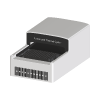 Thermo Fisher Scientific Automated Thermal Cycler (ATC) 96-well PCR cycler with automated lid, built for robot decks.
The Applied Biosystems Automated Thermal Cycler (ATC) is Thermo Fisher’s PCR thermal cycler for robotic systems. Thermo describes it as its smallest thermal cycler footprint, and splits it into two parts: a block module that sits on the robot deck, and a separate control module. The control module connects by a 10 cm, 1 m or 3 m cable, so it can sit under the cycler, under the deck or up to 3 metres away.
The lid is automated, so a liquid handler or plate stacker can load the cycler without an operator. Thermo states that the heated cover slides forward over the plate nest to ensure thermal contact and prevent evaporation, and that the block takes full- or half-skirted 96-well plates. Thermo also states that the ATC is the only one of its thermal cyclers with the raised heating block that full-skirted plates need.
Revolution lists this device as Automated Thermo Cycler.
In Revolution, this driver is a scaffold. It registers the cycler so that a system can be configured against it, and nothing more: it opens no connection and sends no command. The rest of this page is precise about where that line falls.
At a glance
Section titled “At a glance”| Type | Automated 96-well PCR thermal cycler, block and control modules |
| Block | 96-well, 0.2 mL; full- or half-skirted plates |
| Temperature accuracy | ±0.25 °C (35.0–99.9 °C) |
| Max ramp rate | 3.5 °C/s block, 1.8 °C/s sample |
| Lid | Automated; heated cover slides over the plate nest |
| Instrument automation interface | APIs for robotic platforms; SiLA Rapid Integration-compatible, per Thermo Fisher |
| Revolution transport | None — the driver opens no connection |
| Revolution control | None. One diagnostic operation that writes to the Revolution log |
Specifications
Section titled “Specifications”Thermo Fisher publishes the following in the Automated Thermal Cycler specification sheet (COL02724 0916).
| Block format | 96-well, 0.2 mL block, compatible with full- or half-skirted plates |
| PCR volume range | 10–100 µL for full-skirted plates; 20–100 µL for half-skirted plates |
| Temperature range | 4–105 °C |
| Temperature accuracy | ±0.25 °C (35.0–99.9 °C) |
| Temperature uniformity | ≤0.50 °C, 20 s after reaching 95 °C |
| Max block ramp rate | 3.5 °C/s |
| Max sample ramp rate | 1.8 °C/s |
| Temperature calibration | Traceable to NIST standards |
| Block module dimensions (H × W × D) | 13.3 × 17.9 × 31.7 cm |
| Control module dimensions (H × W × D) | 7.0 × 25.7 × 33.1 cm |
| Weight | 9.4 kg total (block module 6.0 kg, control module 3.4 kg) |
| Power | 100–240 V, 50–60 Hz, max 600 W |
| Data connectivity | LAN |
| Hardware integration | Predrilled mounting and/or alignment points at each corner of the chassis; 3-side and top plate access; 3 connector configurations |
| Software | APIs for integration with robotic systems; SiLA standardised programming access; free software for demonstration and stand-alone operation |
| Ramp programming | User-defined ramp rates, or preprogrammed simulation modes including the GeneAmp PCR System 9700 |
The spec sheet notes that half-skirted plates need the ATC semi-skirted adaptor. Thermo’s current catalogue page differs from the 2016 sheet in a few places. It gives the thermal range as 0–105 °C, lists USB, Wi-Fi and Ethernet as interfaces, and gives the weight as 6 kg, which matches the block module alone. Confirm the figure that matters to you against the catalogue entry for your unit.
Plate skirt is the specification that decides integration. The block takes full-skirted 96-well plates directly. Half-skirted plates need the adaptor and have a higher minimum PCR volume of 20 µL. Thermo designates its MicroAmp EnduraPlate Optical 96-well full-skirted plates for use with the ATC.
Supported methods
Section titled “Supported methods”None that reach the instrument. The driver declares a single operation, Debug, which writes the message it is given to the Revolution device log and does nothing else. Initialising the device writes a log line and likewise talks to no hardware.
In practice, a schedule cannot open or close the lid, start a PCR method, or read the block temperature or run state. Any cycling that happens while a plate is in the ATC is started outside Revolution, from Thermo’s own software or another controller. A schedule that routes a plate through this device and expects it to come back amplified is relying on something outside Revolution.
The model Revolution uses for this device carries a plate location, so a mover can be taught to place on and pick from the block. Revolution treats it as a plain stop on the plate’s route, and it cannot open the automated lid first.
Integration
Section titled “Integration”Revolution reaches the cycler only as a configured device. There is no transport, no vendor software in the path and no process model. Thermo Fisher states that the ATC is compatible with SiLA Rapid Integration standards and provides prewritten APIs for major robotic platforms. The Revolution driver uses neither.
Prerequisites
Section titled “Prerequisites”- The lid must be open before a mover places or picks a plate. Revolution cannot command it.
- PCR methods must be programmed and started from Thermo’s software or another controller. A schedule step cannot start one.
- Timing must be arranged by hand. Because Revolution cannot ask the cycler whether a run has finished, a schedule cannot wait on one.
Device configuration
Section titled “Device configuration”| Property | Purpose |
|---|---|
| — | The driver declares no configurable device properties. Only the standard device settings — name and locations — apply. |
If you need more of this instrument driven from a schedule, get in touch — the driver is extended on demand.
Operations
These are available from a Run Device Operation step.
Debug
Writes the given message to the device log and does nothing else. This driver is a scaffold awaiting implementation, so no command reaches the instrument.
| Parameter | Type | Default | Description |
|---|---|---|---|
| message | string | Automated Thermo Cycler debug |
Raise Error
Makes this device report a failure on demand: the step fails with an error naming the device, and the operator is offered the usual error recovery choices. No command reaches the instrument and nothing moves, and the failure is raised in simulation as well as on a real system, so this is the step to use when rehearsing how a schedule handles a device failure.